
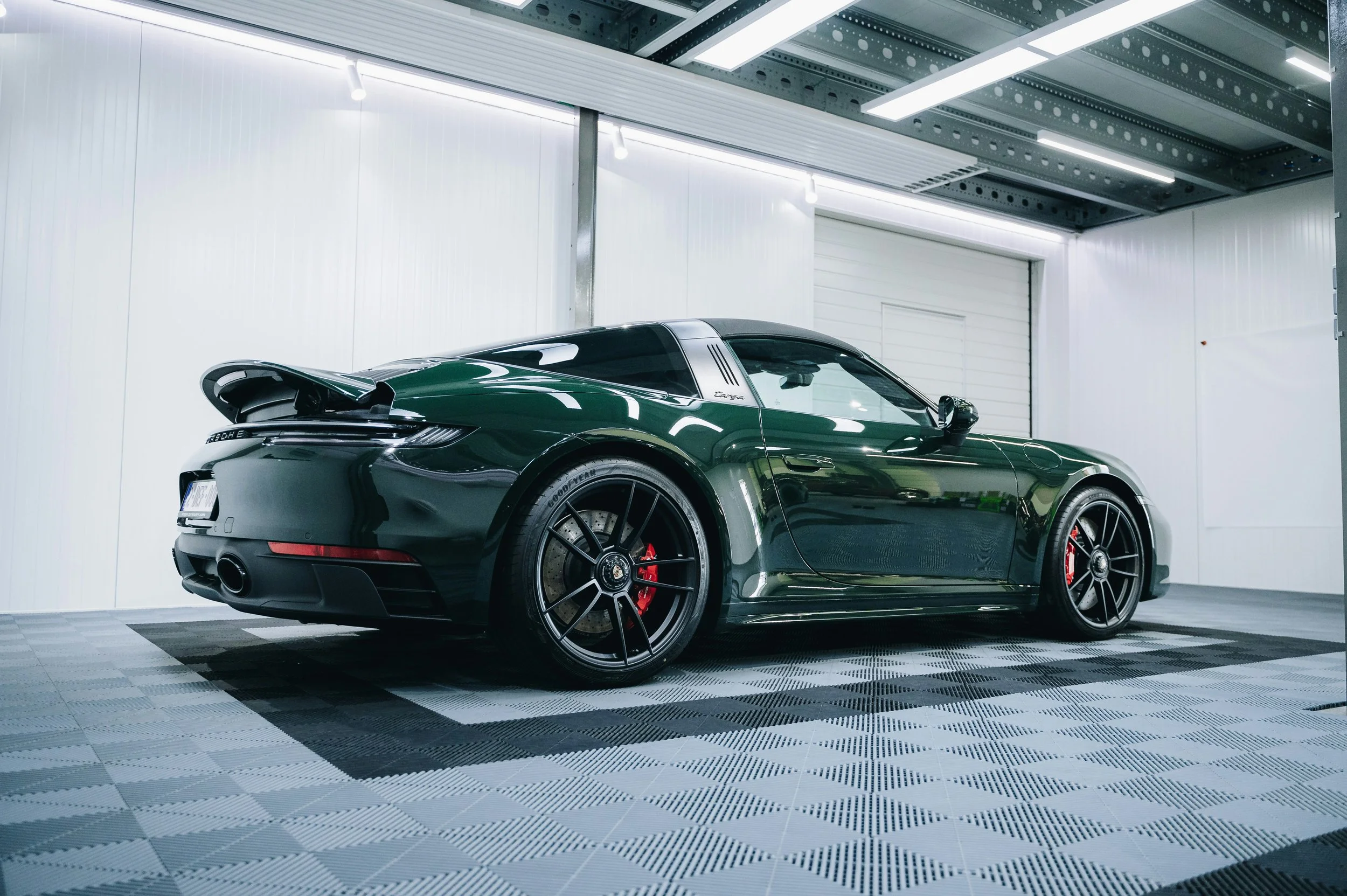
Most buyers walking into Brown Wraps think of PPF as protection against rocks. That's accurate but underplays the real value: PPF preserves the factory finish, and factory finish is what the next buyer pays a premium for.
Resale economics on a $80K car
Take a 2023 Porsche 992 Carrera bought at $130K. Held for 4 years. Sold private party. Standard market depreciation lands the resale around $95K — assuming the paint is factory-original and the front bumper, hood leading edge, and rocker panels look untouched.
That same car driven the same 4 years without PPF in Miami: rock chips on the front bumper (every commuter on US-1 collects them), stone chips on the hood leading edge, sandblasted rockers from beach trips. Cosmetic respray on those panels: $3,500–$5,000. Buyer discount because the car has "had paint work": often $4,000–$8,000 below comparable original-paint cars.
So the gap between PPF and no-PPF on this hypothetical resale is $7,500–$13,000. The PPF install cost was $2,800. The math is dramatic.
Why factory paint matters in the luxury used market
Luxury used buyers do paint depth checks. They look at panel gaps. They use a paint thickness gauge to verify factory thickness across panels. Any panel that reads outside spec is a re-spray, and repaint reduces buyer confidence and trade value.
PPF maintains factory paint thickness — the film comes off cleanly when a buyer wants to see the original. We've handed back several pre-sale inspections where buyer specialists confirmed the paint was 100% factory under the film.
Coverage that matters for resale
- Hood leading edge — the most chip-prone area on any car
- Front bumper — rocks, parking impacts, sun
- Front fenders — backup-into-pillar damage zone
- Mirror housings — scuff zone, hard to repaint cleanly
- Door cups — fingernail and key scratches concentrate here
- Rocker panels (lower side panels) — sand and rock kickup, sun fade
- Rear bumper top — luggage, bumps, dings
"Track Pack" coverage on luxury vehicles addresses all of these — that's why we recommend it for $80K+ vehicles intended for resale.
What about lease vehicles
Lease returns penalize cosmetic damage at fair-market-disposition rates. A typical lease return inspection charges $400 for a single rock-chip-cluster bumper, $700 for noticeable hood chips. PPF prevents both.
For a 36-month lease, PPF often pays for itself just at lease return — and the original paint underneath is untouched.
A simple decision framework
- Hold less than 2 years, plan to sell: minimum full front PPF
- Hold 3–5 years, plan to sell: track pack PPF
- Hold 5+ years, plan to keep: full body PPF + ceramic on top
- Lease vehicle: minimum full front, ideally track pack
For Miami specifically, factor in coastal salt and storm debris. Both age unprotected paint faster than national averages, which makes PPF math even better here than in drier climates.